Since I was unable to find any straight and simple posts on desktop search in Ubuntu (or most other Linux dists for that matter) I decided to post a brief note on it here.
It seems that the only viable option today, at least if you're looking for a clean interface with enough of a powerful engine, is Beagle. The simplest way to obtain it is via an apt-get:
sudo apt-get install beagle
Now, before you start the indexing, you might want to enable extended attributes on your filesystems. Not doing this apparently slows the indexing down multifold, so it's highly recommended. This is documented somewhere on the Beagle site, but what ended up doing was adding 'user_xattr' to the options in /etc/fstabs, like:
/dev/hda2 / ext3 defaults,user_xattr,errors=remount-ro 0 1
Notice how everything else remains unchanged from the default settings. Then, I remounted the above partition using:
mount -o remount /
CAUTION: There are reports of incidents when adding extended attributes, so proceed with caution. For me it worked perfectly though.
The final thing is to start the indexing, by launching
beagle-search
and going to 'Preferences'. Under the 'Indexing' tab you can now add whichever directories you want indexed. Notice how e.g. adding a certain directory will remove any entries further down in the hierarchy, e.g. '/' will remove '/usr', since it will be included in the search anyway.
Now Beagle starts its work, and you can monitor its progress by issuing:
beagle-index-info
and to actually search, use
beagle-search
As a side note, the daemon is called 'beagled'. If anything seems fishy with your indexing, you can always try confirming your settings and manually killing and restarting the processes:
sudo killall beagled
sudo beagled --replace
That's about it. Stay tuned for more Ubuntu action.
Saturday, September 23, 2006

Enter Ubuntu
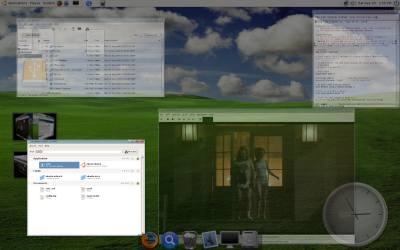
So a couple of weeks ago I finally got around to installing a decent Linux dist. After a brief survey I settled for Ubuntu, most of all since I'm sitting on a HP laptop which I'd rather avoid tearing apart just to find specific part numbers etc. Also I happened to catch a glimpse of Ubuntu successfully running XGL and Compiz, i.e. OpenGL-accelerated window management for those of you who - like me - have spent the last couple of years living either under a rock or at the local pub.
Anyhow, after lots of work I finally have my sweet, whobbly, swooping, zooming desktop up and running, complete with sleek desktop search, fully working OpenGL development facilities and everything else that I've been looking for in an alternative to MS Windows.
Everything except Houdini that is, which I am to learn before my internship at Digital Domain starts within a couple of months. Hence I'm still bound to my old XP installation, although once I'm done with Houdini I might just throw it out the window once and for all.
My goal is to post a couple of brief walkthroughs or at least sketchy notes of my Ubuntu endeavors in this forum within the nearest future.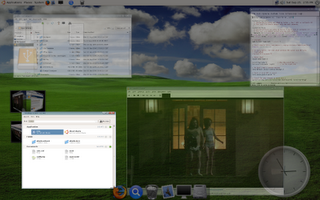

Anyhow, after lots of work I finally have my sweet, whobbly, swooping, zooming desktop up and running, complete with sleek desktop search, fully working OpenGL development facilities and everything else that I've been looking for in an alternative to MS Windows.
Everything except Houdini that is, which I am to learn before my internship at Digital Domain starts within a couple of months. Hence I'm still bound to my old XP installation, although once I'm done with Houdini I might just throw it out the window once and for all.
My goal is to post a couple of brief walkthroughs or at least sketchy notes of my Ubuntu endeavors in this forum within the nearest future.

Sunday, June 11, 2006
Google Analytics
Wow. Regardless of their alleged world domination schemes and general evilness, Google went and did it again. Google Analytics is an awesome service that lets me monitor the traffic to my official webpage and extract all kinds of statistics, such as graphical region, source site, conversion rates etc, everything neatly packed and categorized. It's oh so simple (just copy-paste a scriplet into your html files), and yet has given me a complete new view of what good (if any) that my webpage actually does. So get in line and wait for that precious invitation today!
Thursday, May 11, 2006
Ron Fedkiw interview at fxguide
There's a really interesting interview with Prof. Fedkiw at fxguide.com. He describes in some detail what's going on under the hood of those cool new water animations we see in the movies. It's fun to see what all this &#!?%$# math hopefully is leading up to!
Saturday, May 06, 2006
Optimizing noisy 1-D functions
 Who knew such a trivial thing as finding the maximum of a noisy 1-D function would prove an unsurmountable task to modern science! While some people are fusing atoms and creating anti-matter, others are screaming in frustration over non-convergent searches and galloping derivatives when trying to focus a simple lens system in a ray tracer. Stochastic sampling in all honor, but for a tremendously costly function (e.g. ray-tracing a focus area and computing its entropy) you don't want to risk wasting those precious samples in potentially all the wrong places. Yes yes, auto-focusing a ray-tracer using the same focus measures as a normal camera might not be the smartest field to invest time in, but school assignments usually aren't picky about realism. Also, I'm sure there's plenty of other applications of a smart search algorithm for noisy data. Golden Section can't reign supreme forever! Right?
Subscribe to:
Posts (Atom)